


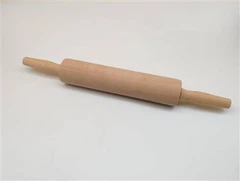

The origin of rolling pin can be traced back to ancient Egypt. The earliest rolling pin was made of a wooden stick called "Dhekkel", which is similar in shape to the modern rolling pin, but without a handle. People held the stick directly with their hands and used the strength of their arms to roll the dough flat. As time went on, people gradually realized the inconvenience of rolling dough with arm strength, and began to try to add handles to facilitate operation. The original handle was tied to the stick with a rope or belt, but this method was not strong and easy to slip. It was not until the early 19th century that the Italians invented a rolling pin with a metal bearing. The handle and the stick of this rolling pin were connected by a bearing, which could Будьте легко котяться і дуже зручні . Ця конструкція згодом була широко прийнята і стала прототипом сучасного рухомого штифта .
Винахід шпильки, що котиться, не тільки полегшило кухонне життя людей, але й полегшив приготування їжі простіше і швидшого ., чи робить вона локшиною чи випічки, котяча шпилька відіграє життєво важливу роль .